
Durham County Wanted Fugitives
The official Durham CrimeStoppers suspects page is the public face of the wanted list. Its cards come with filters for crime type and status. Three sections organize everything: "Wanted Persons," "Can You Identify?," and "Hot Sheets (Through Dec. 2024)." The labels matter. A person being sought, an unidentified figure in an investigation, and an older hot sheet each carry different weight.
No stable headcount exists to quote here. Cards come down when someone is arrested, when a status gets corrected, or when law enforcement changes its request. Expect each entry to carry a name, date of birth, the wanted reason, a status, and a photo when one was supplied. Photos stay on the CrimeStoppers page itself rather than in any copied gallery. Sheriff's Office releases can add context around a capture or a broader campaign, but a release alone is selective. It won't replace a live custody table, a docket, or a full warrant inquiry. Anyone chasing a booking record should match name and date against the Durham County custody and arrest records first. Then look at what the court decided.
To see the current cards directly, visit the official Durham CrimeStoppers suspects page. Whatever photo or status appears there is the source of record. The live filters deserve a fresh look before you rely on any single entry.
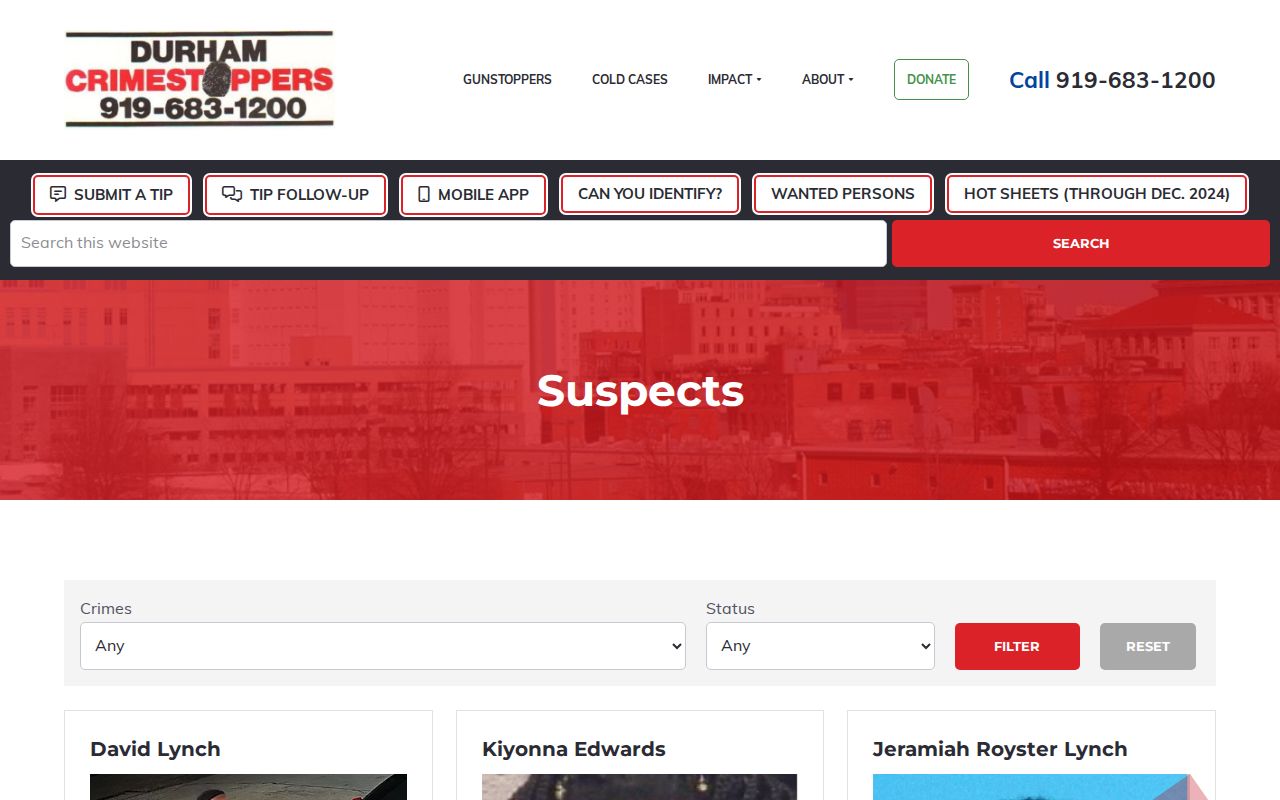
What you see is a filtered wanted interface, not a full Durham County arrest list. Treat its status and reason fields as leads. Confirm any custody or court claim with the agency responsible.
Durham Wanted Listing Fields
A CrimeStoppers card is built for awareness and tips. It carries enough detail to tell one request from another, yet not enough to settle every legal question. Compare the card's wording and status against the official source date before you share anything.
| Field | What it can show |
|---|---|
| Name | The person named by the participating agency or CrimeStoppers entry. |
| Date of birth | An identifying detail shown on some cards, useful for avoiding a mistaken identity. |
| Alleged offense or wanted reason | The reason supplied for the request, not a court finding. |
| Status | A changing label such as wanted, identified, or arrested when the organization updates it. |
| Photo | An image when supplied by the source. It stays on the official listing and is not a conviction record. |
| Tip direction | The route for sending information to CrimeStoppers or the responsible agency. |
A status change is not a case outcome. "Arrested" means the person was taken into custody, nothing more. The court process may later reduce, dismiss, or amend the charge. An active card can vanish too, sometimes without public explanation. Keep the source date handy. Never read a missing card as proof of any particular result.
Note: A wanted card is a public tip request with a changing status, not a certified warrant record or final court judgment.
Use the Durham Wanted List
Read the list as information, not an invitation to act. A card's photo and name can help a witness decide whether they know something useful. A shared name or a similar face won't carry you far, though. Never follow, confront, threaten, or try to detain anyone shown on a card. Leave that work to the officers assigned to it.
- Open the official CrimeStoppers suspects page and choose the relevant list or status filter.
- Read the name, date of birth, alleged reason, and status together. Note that the card may have changed since an earlier share.
- If you recognize a person or know where useful evidence may be found, use the official tip route. Do not post a location or identifying claim as a confrontation tool.
- For a custody question, compare the person and dates with DCSO or the arresting agency. A wanted entry is not a booking record.
- For the case result, use the docket and court record. A booking or wanted card remains an charge until the court resolves the case.
A tip and a warrant check are different animals. One sends information to law enforcement. The other asks an authorized source about a court-directed arrest process. Durham agencies publish the proper route for each, so use those channels rather than improvising.
Durham Tips and Rewards
Durham CrimeStoppers takes anonymous tips at (919) 683-1200. Call anytime. Staff work around the clock, and some speak both English and Spanish. You never have to give your name. Rewards usually run from $100 to $2,000. How much you get depends on how serious the crime is and how useful your information proves. Follow-up happens on weekdays during business hours. The live FAQ governs any current process detail, so check it before you count on anything.
Durham CrimeStoppers
Anonymous tip line: (919) 683-1200
Bilingual and 24-hour availability described by the official FAQ
Typical reward range: $100 to $2,000
Read the official tip FAQ
The City of Durham CrimeStoppers page lays out how anonymous tips work and when rewards get paid for useful information. Sending a tip does not lock in a reward, though. The program decides on its own whether the information earned one.
Emergencies belong on the emergency line. Use the one the responsible agency provides. Never route an urgent safety concern through a public comment thread. For tips meant for the sheriff, Durham County Sheriff's Office runs its own anonymous channel. Check its published phone line and email before using it, since monitoring details can change. CrimeStoppers and DCSO take tips. Neither is the right place to ask about a private warrant result.
Durham Wanted List Versus Warrant
Durham's wanted list and its warrant system are not the same thing. The list exists to gather tips. Some entries may track a warrant. Others reflect only an investigative request. So a name missing from the list does not clear that person. The DCSO FAQ is blunt about phones: Warrant Control will not give out active-warrant information over a call.
That refusal actually helps. The jail is not a warrant hotline either. No third-party card can stand in for the real channel. Think a warrant might name you? Get a lawyer. You can also go through the Durham Clerk of Court or Warrant Control. Never lean on a public list to dodge the issue. The DCSO warrant FAQ wording comes straight from the sheriff's site, and instructions can shift, so verify directly with the Clerk of Court or the Warrant Control Center before acting on it.
Check a Durham County Warrant
North Carolina courts use a handful of terms for arrest and case processes. The labels rarely overlap cleanly. Durham's official route centers on a person resolving the matter through counsel or the court itself, not on searching a photo database. A careful check stays quiet and procedural. Follow the steps laid out below, and keep the question focused on the record rather than on any confrontation.
- Speak with an attorney if there may be an active warrant, order for arrest, or failure-to-appear issue. Counsel can help identify the safest lawful next step.
- Ask the Durham Clerk of Superior Court at 510 South Dillard Street about the court record and the filed case information. The clerk route is not a substitute for legal advice.
- Use the Warrant Control Center inside the Durham County Jail at 219 South Mangum Street for the route identified by DCSO. Confirm current access rules before going there.
- If self-surrender is the chosen path, DCSO’s general FAQ describes Monday through Friday, 7 a.m. to 11 p.m., with government photo identification. Verify those instructions first.
- After the custody question is resolved, use the court docket to follow hearings and disposition. Do not assume that surrender or release means the charge was proven.
Start with the Durham Clerk criminal and traffic page for local clerk records. And whatever you learn, never approach someone on a wanted list or send a stranger to intervene.
Durham Warrant and Court Terms
Each label below describes a distinct legal step. The differences matter. For the exact reason in any one case, read the court file or ask the agency handling it. A copied card from a third-party site will not carry that answer.
| Term | Plain meaning |
|---|---|
| Arrest warrant | A court-directed process authorizing arrest after the required showing of probable cause. |
| WFA, or order for arrest | A court order that can arise from failure to appear, failure to pay, contempt, child support, or another listed circumstance. |
| Criminal summons | A direction for a person to come to court. It is not itself an arrest. |
| Bench warrant | A common name for a warrant issued by a judge in connection with a court appearance or compliance issue. Confirm the exact label in the case. |
| Disposition | The later court result, such as dismissal, plea, acquittal, or conviction. |
Note: A criminal summons calls a person to court, while a warrant or WFA can direct an arrest; the filed case controls the details.
Safety, Status, and Innocence
Safety first. Do not approach, follow, photograph, or confront someone because of a wanted card. Send information through CrimeStoppers or the responsible agency, and use emergency services for an immediate threat.
Reading a wanted list takes a clear head. Someone on it is being sought or accused, and a photo there is an identification image tied to an event. Case outcomes can go many ways: charges get reduced, dismissed, amended, resolved by plea, or result in a not-guilty finding.
For a full record, follow the order: custody, court, disposition. The DCSO roster shows who is in custody now or was held recently. Someone released from the Durham County Detention Facility may drop off that view, though. The court docket sticks around after release and carries the rest of the case history. Keep those states straight when you read or share what you find.
Note: Durham’s wanted cards, custody rows, and court entries answer different questions, so one status should never be used as another.