
Durham County Crime News Sources
Go to the official sources first, then the news. For arrests inside the city, the Durham Police Department P2C and Daily Bulletins notice lays out where adult arrest and incident data may appear. For anyone in county custody, the DCSO Inmate Population Search is the snapshot that governs. A news item can point you toward either one. It just cannot stand in for the record itself.
Each source answers a different question. DPD records track municipal events after review. DCSO shows the detention side: confinement dates, charges, bond, docket, and release fields in the public table. Timing diverges too. A person can sit on the jail roster before any bulletin mentions the arrest, or appear in a story after release, once the roster no longer lists them.
That gap is why dates and agency names matter so much. A headline saying "Durham" can mask a booking in Orange or Wake County. A city name, a home address, or an outlet's tag proves nothing about custody. Match the event, the agency, the date, and the court county before you connect any two records.
| Source | Best use | Photo expectation |
|---|---|---|
| DCSO roster | Current or very recent Durham County custody | No photo shown in the checked public table |
| DPD P2C and bulletins | Durham city adult arrest and incident entries | Event data, not a guaranteed photo feed |
| Local news | Story context, selected images, later updates | Article-dependent and not complete |
| NC eCourts | Hearings, case events, and disposition | Not a booking-photo source |
Durham Arrest News From DPD
Durham Police releases information through several channels. The P2C Event Search holds adult arrests and selected incidents filed since October 1, 2016. Daily Bulletins follow once entries are entered and reviewed. Expect a lag of several days, DPD cautions. That delay is worth remembering. A name missing from a bulletin does not mean no arrest happened.
The city's crime statistics and open-data page connects to weekly crime reports, period-to-date tables, shooting data, and a weekly gun-related-arrest series. These are statistical and thematic publications rather than a full jail feed. The gun-related-arrest archive may include a date, arrest mode, charge headings, charge text, and mugshot-style images for the cases a given report covers.
This pattern differs from the DCSO roster. DPD publishes a report because an arrest fits a weekly category. DCSO lists a person because that person sits in county custody or was released recently. Treat any image in a DPD report as an agency release tied to that report. Not every Durham booking gets a public photo.
Note: DPD’s several-day posting warning makes the report date and the arrest date separate facts that should both be recorded.
Durham Mugshots and Court Records
For current custody questions, start with the DCSO roster. Its public table showed no booking photograph, though. What it did display was the person's name, dates confined, charged, and released when applicable, statute description, bond type and amount, court docket, and days in jail. A name link leads to VINE notifications, not to a photo page.
Photos in news stories deserve a closer look. Who supplied the image, and when? It could come from an agency, a jail booking, surveillance footage, or the scene. If you need a booking photo and no official page shows one, a focused request to the DCSO Records Division or the arresting agency is the right move. No public DCSO booking-photo feed exists to check.
The paper trail keeps going after the story ends. Copy the docket from the roster or article and search the North Carolina eCourts Portal, which can show case events, hearings, parties, and dispositions, though not as a certified copy. For a missing or certified Durham criminal record, turn to the Durham Clerk of Superior Court criminal and traffic page.
Record boundary. A news story, custody row, and court disposition are three different records. None should be described as a conviction unless the court record supports that exact result.
Durham Local Crime Coverage
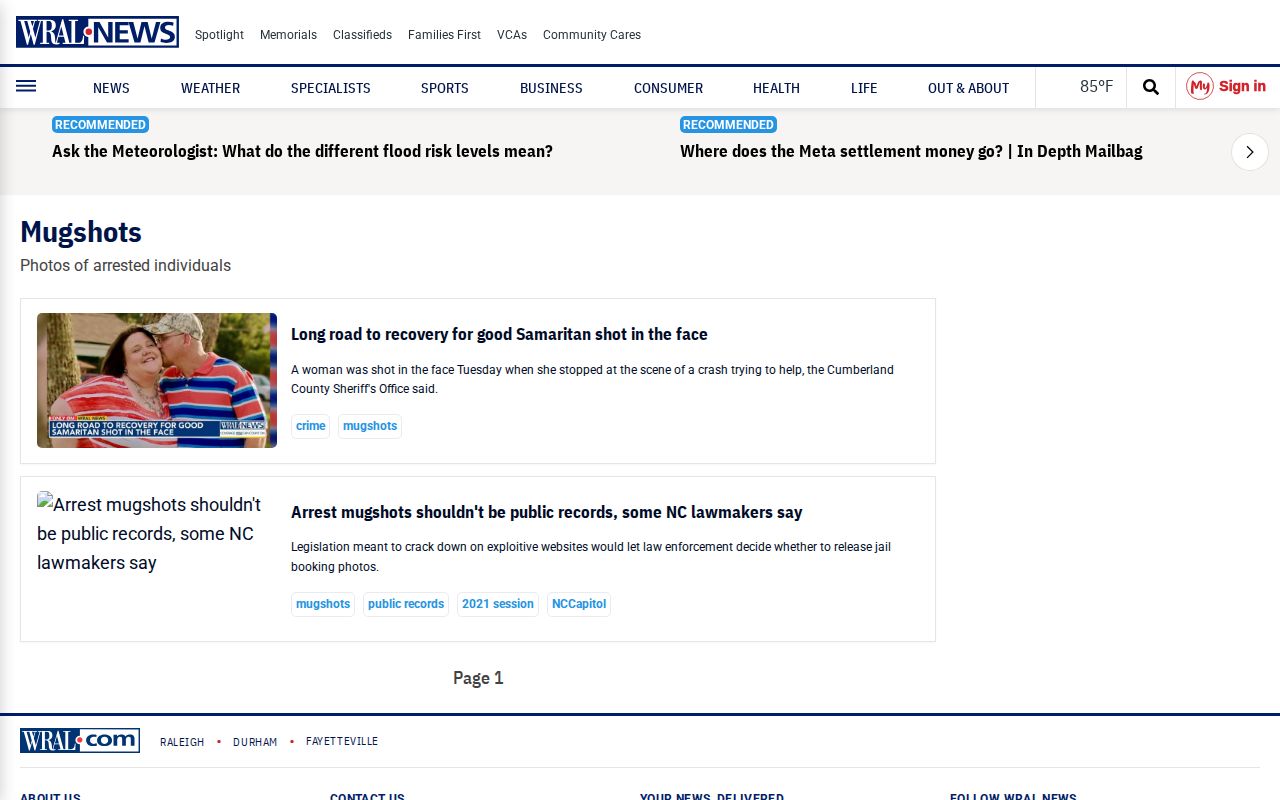
For mugshot coverage tied to Durham arrests, WRAL stands out. The station builds its archive from material supplied by the Durham County Sheriff's Department, and it frames its mugshot pages around stories rather than a fixed daily roster. Expect a mix of Durham city, Durham County, and wider Triangle cases. Always confirm which agency actually holds the person.
The Herald-Sun keeps a local crime section with a steady stream of Durham County reporting. Photos there vary. Some come from police, others from surveillance footage or the courthouse, and some are booking images. The News & Observer's local crime section takes a regional angle too, and it often shines when a later court development matters more than the initial bust.
TV stations round out the picture. CBS 17 maintains a Durham County news section, and ABC11 offers both a Durham news page and a Durham Police topic page. None of these run on a booking schedule. Editors pick which arrest stories get photos, so the images are selective. A regional piece may even center on a different county or agency entirely.
The WRAL mugshot page is the publisher's news interface, not a gallery of county booking photos.
Open WRAL's Durham mugshot news coverage to browse the current archive and read how the station describes its sources.
Unofficial Durham Mugshot Indexes
Unofficial indexes have their uses. They can surface an old story or show how a booking record spread across sites. They are not custodians, though. Entries can lag, repeat, vanish, or simply be wrong. Official sources should always come first in any search.
Busted Newspaper's Durham County section pulls Durham bookings from a public database. Each record pairs booking dates, charges, and photos. Updates run on the site's own pace, not a promised DCSO schedule. A separate Chapel Hill PD route exists there too. The site offers a free correction and removal form for qualifying records. A request there cannot touch the official court docket, though.
RecentlyBooked's North Carolina index has no confirmed Durham local section, and guessing a Durham URL is a bad idea. Its national policy promises free review for inaccurate, duplicate, juvenile, sealed, expunged, or otherwise eligible records. None of that makes the state index a current Durham feed.
Mugshots.com's Durham County page is a sprawling unofficial historical index. Counts and area tags shift over time. Its published maintenance process allows free review, plus updates or removal in qualifying circumstances, with documentation and a stated review window. Area tags prove nothing about custody. Verify anything that matters with DCSO, the arresting agency, and the court.
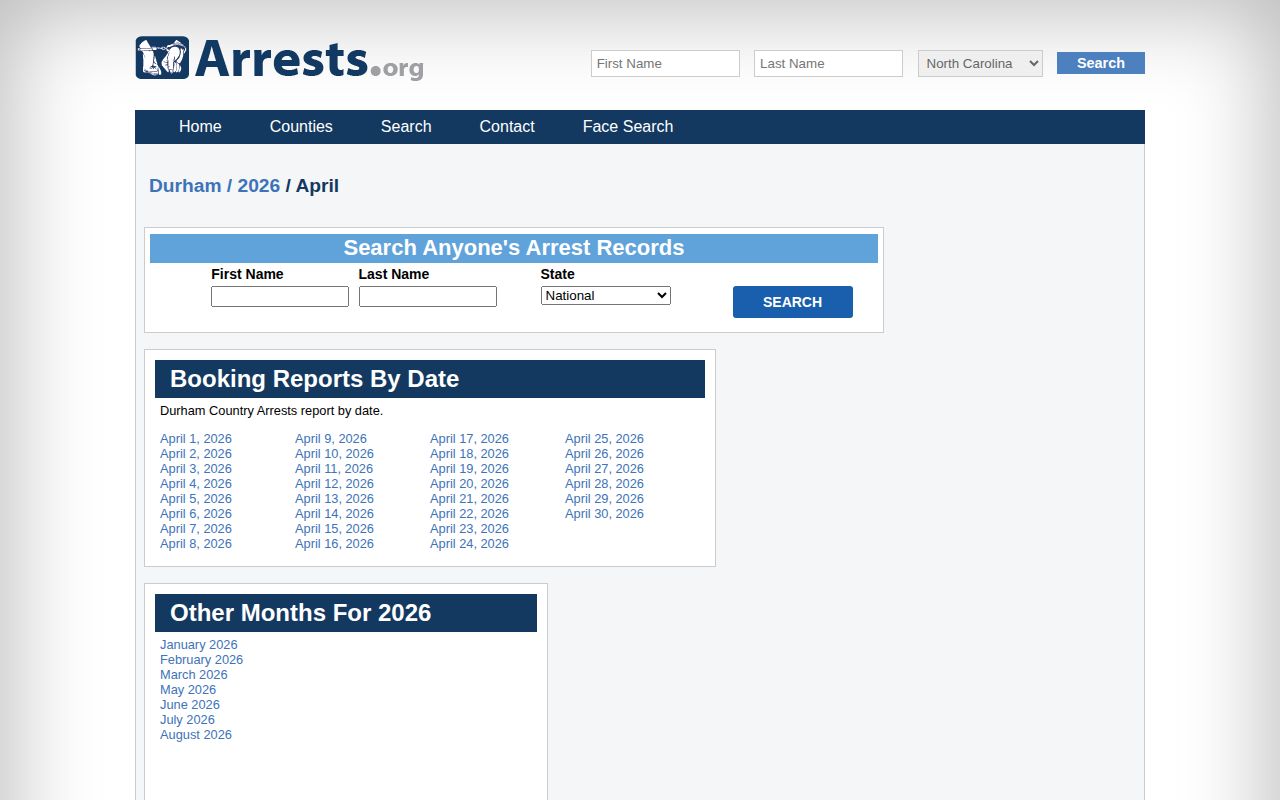
Arrests.org handles Durham through date-indexed year and month paths. Names, charges, and photos sit on the detail pages. The April 2026 Durham index shows that multi-day format in action. A daily link is no promise that DCSO supplied the record or still maintains it. Mugshots.zone has no verified Durham local section. JailExchange is just a facility explainer, not a booking-photo source.
Treat the Arrests.org Durham date index as a cross-check only, after you have pinned down the official agency and custody county.
Mugshots.com and Arrests.org can keep a record alive long after a person leaves county custody. That staying power cuts both ways. Say a court later grants an expunction. Say the record is flat wrong. Use the source's published free process, and hold onto the official order or correction paperwork. Nobody should assume paying money is the only lawful route to fix an error.
Check a Durham News Record
A quick source check prevents the most common mix-ups. Begin with the agency named in the story. Then compare dates and place names. A piece about a wanted person belongs with the official CrimeStoppers or sheriff source, not automatically with the jail roster. For a county booking story, hunt for DCSO's custody fields and a docket number.
- Write down the article date, arrest date if listed, person’s name, alleged charge, and arresting agency.
- Check DPD or the responsible police department when the story concerns a city arrest. Allow for DPD’s stated several-day delay.
- Check DCSO when the person is thought to be in Durham County custody. Record the roster’s last-updated time and release field.
- Search the docket in NC eCourts. Read events and disposition entries instead of treating the first charge line as the final result.
- If a record or photo is missing, request an existing record from the agency that holds it. Do not treat an unofficial copy as official.
Chapel Hill and Raleigh demand extra care with geography. Ordinary Chapel Hill bookings typically route through CHPD into Orange County. Ordinary Raleigh bookings route through RPD into Wake County. A Durham County population share changes nothing. A Triangle news label does not either. Neither one shifts a booking into DCSO custody.
Durham Arrest Stories Need Context
An arrest story in the news is usually written fast. At that point, all anyone knows is the initial charge plus whatever the reporter gathered at the scene. A booking photo, when an outlet runs one, simply documents that the person was processed. It shows an event. Not an outcome.
Court papers filed weeks or months later can change the picture completely. Charges get dismissed, reduced, or resolved through a plea. An arrest record can even be sealed or expunged, though old copies don't vanish everywhere at once. A news site may update or pull its article. A search result or unofficial index can keep showing it long after. For the true legal status, trust the court and the arresting agency.
A smart reading habit has three parts. Check the official agency pages for the arrest itself and the custody snapshot. Turn to local reporting for context and follow-up. Then read the court file for how the case ends. Keep custody terms straight, too. Just booked, still held in Durham County custody, released, on state supervision, in federal custody, or detained under an immigration process all mean different things. They are not interchangeable labels.
Note: A Durham news item can be useful evidence of what was reported, but it is never a substitute for the current agency record or court file.